
Imagine you've just been asked by your CEO to develop a new product strategy.
You know how to approach it. You start examining the market, talking to customers, evaluating competitors, identifying opportunities, and considering where the product should go next.
A few weeks later, you present a well-researched strategy. Your recommendations are supported by evidence, the opportunities are compelling, and the roadmap is realistic.
And yet, the executive team isn't convinced.
The CEO challenges your priorities. The CFO questions the investment. Someone asks how quickly the proposed initiatives will contribute to revenue.
You might walk away thinking that leadership doesn't understand product strategy.
But there's another possibility worth considering: You developed a good product strategy without first understanding what the business actually needed from you.
The Business Context Changes Everything
One of the most important lessons I've learned throughout my career is that the same product strategy can be an excellent decision for one company and a costly mistake for another.
Consider two software companies operating in the same market, targeting similar customers, and facing comparable competitive pressures.
The first is an early-stage, venture-backed business that recently raised capital. Its immediate priority may be establishing product-market fit, expanding into new segments, or developing capabilities that create future differentiation.
The second is a mature, private-equity-owned company preparing for an exit. Its priorities may be improving profitability, protecting recurring revenue, reducing operating costs, or demonstrating predictable growth.
Both companies might identify the same customer opportunity.
But the strategic value of pursuing that opportunity could be fundamentally different.
For the first company, investing in a new product capability could create the foundation for its next stage of growth.
For the second, the same investment might consume capital and engineering capacity without producing returns within the company's required time horizon.
The opportunity hasn't changed. The customer needs haven't changed.
What has changed is what the business needs from Product, how much it can afford to invest, and when it needs to see a return.
The Questions That Come Before Product Strategy
Product leaders spend considerable time learning about customers, markets, and competitors. Those are essential inputs, but they don't independently determine what a company should invest in.
Before developing a strategy, there are more fundamental questions worth understanding.
What is the company trying to accomplish over the next 12–24 months? Is the priority accelerating growth, improving margins, protecting retention, entering a new market, or positioning the business for an exit?
What expectations have investors and the board already established? How much capital is available? How much uncertainty can the business absorb? And how quickly do investments need to produce measurable results?
These questions aren't exclusively the responsibility of the CEO or CFO.
Their answers define the economic boundaries within which product strategy must operate.
Without that context, product leaders risk recommending investments that are attractive from a product perspective but inappropriate for the business.
And that misalignment has consequences beyond an unsuccessful strategy presentation.
It can redirect engineering capacity toward opportunities the company cannot afford to pursue, delay more urgent commercial priorities, and gradually undermine executive confidence in Product's judgment.
Product Strategy Is Ultimately a Business Decision
As product leaders, we often discuss strategy through the language of customer problems, differentiation, market opportunities, and competitive positioning.
Executives must consider those same factors through an additional lens: investment, risk, return, and timing.
This doesn't mean customer needs become less important. It means understanding which customer problems the business can create meaningful value by solving, under its current constraints.
The transition from strong product management to executive product leadership requires recognizing that distinction.
Because your responsibility isn't simply to develop the best possible product strategy. It's to develop the right product strategy for the business you are actually operating.
And sometimes, the most strategic contribution you can make is to challenge the mandate before proposing the roadmap.
A Question to Consider
If your CEO asked you tomorrow to develop a new product strategy, would you know what the company most needs Product to accomplish over the next 12 months?
Or would you begin with customers, competitors, and opportunities—and hope those recommendations align with the business?
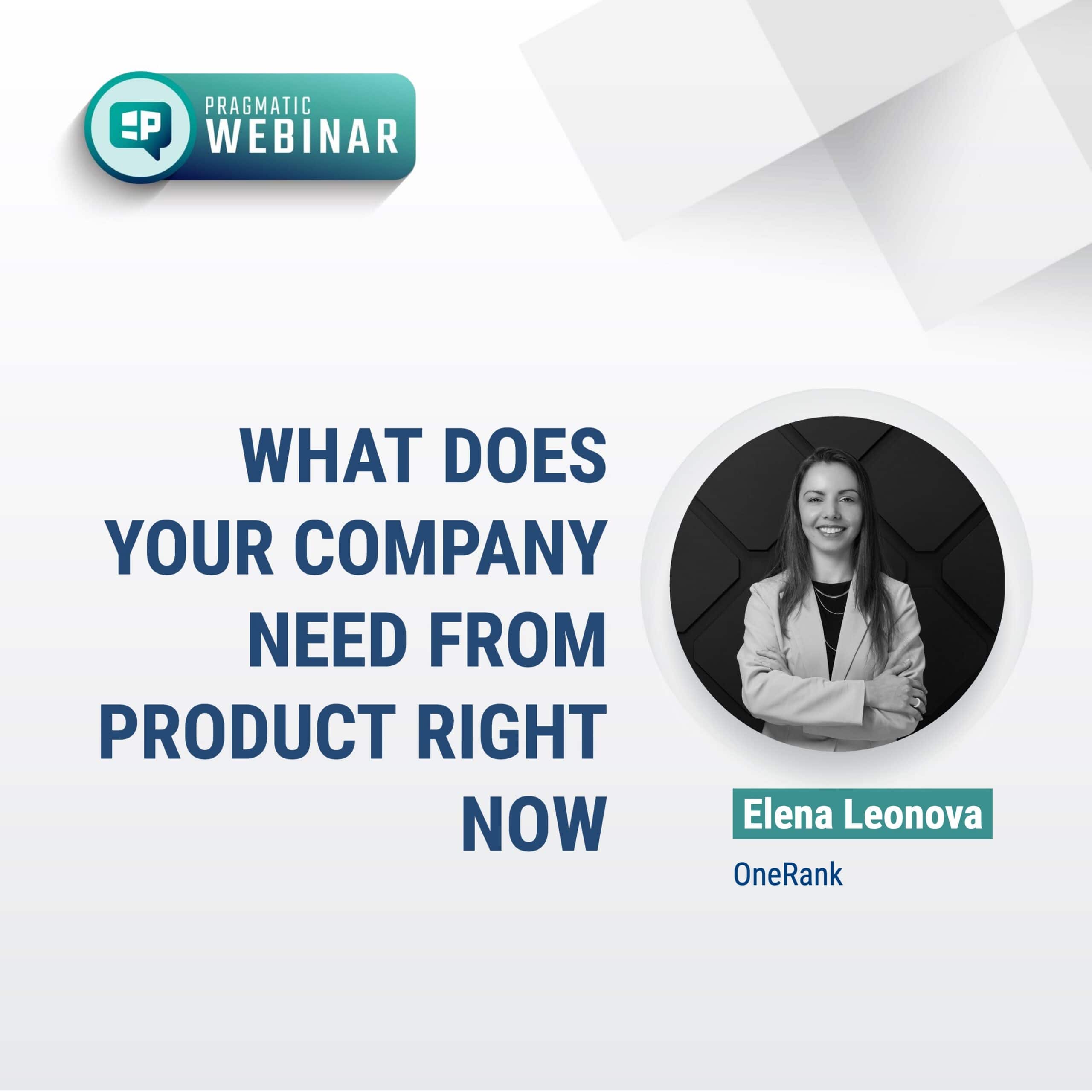
Join Me This Thursday for a Free Pragmatic Institute Webinar
This Thursday, October 29, I'm hosting a free live webinar with Pragmatic Institute: What Does Your Company Need from Product Right Now?
We'll explore how commercially minded product leaders understand their company's business reality before deciding what belongs on the roadmap.
We'll discuss how company stage, ownership expectations, revenue models, and financial pressures influence product strategy—and how to translate those signals into priorities that executives understand.
If you've ever been asked to be more strategic without being given the context needed to do so, this session is for you.
Thursday, October 29, 2026 | 1:00 PM ET / 12:00 PM CT
I hope to see you there.
Until next week,
Elena Leonova
Executive product & business-strategy leader
I work with senior product leaders, founders, and executives on business-first product strategy, platform decisions, and organizational dynamics where the cost of getting it wrong is real.